
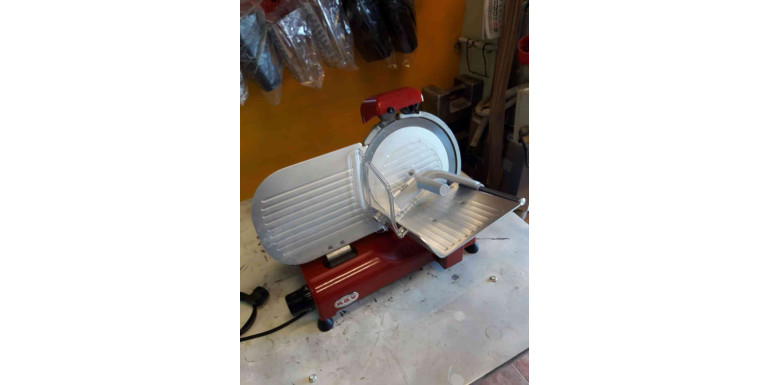
Used meat slicer: what to check before you buy
When you inspect a used meat slicer, Berkel or any other brand, check five things: how much blade is left after years of sharpening, the condition of the sharpener and its stones, play in the carriage and guides, motor and bearing noise, and electrical safety (earth connection, cable, switches and safety microswitches). Then check the CE marking and the paperwork: a commercial slicer without CE marking cannot simply be put to work in a shop as if it were new. This guide gives you a hands-on checklist, the questions to ask the seller and the difference in protection between buying privately and buying from a dealer.
Used slicers: where the risks are
A commercial slicer is a simple, rugged machine, which is exactly why the second-hand market is so busy. But the wear parts are always the same, and a listing with nice photos tells you nothing about them. These are the points to look at.
The blade: how much diameter is left
Every sharpening removes steel. After years of service a 300 mm blade (the classic 12-inch size) can be noticeably smaller than its nominal diameter. The clearest sign is a growing gap between the cutting edge and the blade guard ring around it. A wide gap means less precise slices, a sharpener that struggles to reach the edge and a less effective guard. Our guide on when to replace a slicer blade explains how to spot a blade at the end of its life. Also look for cracks, deep chips, rust or wobble when it spins. Blades can be replaced, but factor the cost in from day one.
Sharpener and stones
The sharpener should fit without forcing, and both stones (the sharpening stone and the deburring stone) should spin freely and meet the blade at the right angle. Glazed, worn or greasy stones sharpen poorly; a bent sharpener or one with a missing cover needs replacing.
Carriage, guides and bearings
The product carriage should glide smoothly with no jerks, grinding noises or sideways play. Grab it and try to rock it across its travel: if it moves, the bushings or guide bearings are worn. A loose carriage gives uneven slices and, at worst, brings the product too close to the blade. Also check that the thickness knob brings the gauge plate back to zero (blade edge covered) and that the carriage lock works.
Motor, belt and drive
Switch the slicer on and listen. A steady hum is normal; whining, squealing, rhythmic metallic noises or vibration point to worn motor or blade bearings. The drive belt should be intact, with no cracks or fraying: if the blade slows down when you push product against it, the belt is slipping or the motor has lost torque. A motor that struggles to start or gets hot within minutes may need a new capacitor or rewound windings. If you are hunting for a used slicer motor, rewinding the original stator is often possible: parts are in our slicer and meat grinder motor stator category.
Electrical safety
This is the most overlooked point and the most important one. The power cable must be undamaged, with no tape repairs, a sound plug and the earth conductor connected to the housing. Start and stop switches must work first time. Many commercial slicers have safety microswitches (for example on the blade cover or the carriage) that prevent start-up when a guard is removed: if they have been disconnected or bridged, the machine is dangerous even though it runs.
CE marking and EN 1974: why they matter
Since 1 January 1995, machinery placed on the European market must carry CE marking under the Machinery Directive (today Directive 2006/42/EC). For slicers the technical reference is the harmonised standard EN 1974, which sets safety and hygiene requirements for slicing machines: blade protection by ring guard and blade cover, carriage guards, controls and cleanability. On a used machine, look for the rating plate with brand, model, serial number, year, voltage and CE mark, and ask for the manual and the declaration of conformity.
In Italy, if the slicer is going into a business (butcher, deli, restaurant), there is a further rule: under article 72 of Legislative Decree 81/2008, anyone selling or renting out work equipment built before the product directives, and therefore without CE marking, must certify that it meets the safety requirements of Annex V of the decree. A vintage slicer with no CE marking and no such certificate is not a machine for a workplace.
Vintage Berkel flywheel slicers: collector's item or work machine?
Many searches for a used Berkel slicer are about the iconic red flywheel models. They are beautiful collector's and restoration pieces, and they slice cured ham superbly, but a model built before CE marking should be treated as a display piece or a machine for home use, not counter equipment for a business, unless it has been brought up to standard and certified. For how they differ from gravity-feed slicers, read flywheel vs gravity slicer. Blades are still available: see our blades for flywheel and Berkel slicers.
Used meat slicer inspection checklist
| Component | What to check | Red flag |
|---|---|---|
| Blade | Remaining diameter, gap to the guard ring, cracks, rust | Wide gap to the ring, chipped edge, visible wobble when spinning |
| Sharpener | Fit, stone rotation, cover | Glazed or worn stones, bent or missing assembly |
| Carriage and guides | Smooth travel, side play, carriage lock | Jerky movement, grinding noise, carriage that rocks |
| Gauge plate and thickness knob | Return to zero, progressive adjustment | Plate not covering the edge at zero, knob slipping |
| Motor and bearings | Noise, temperature after a few minutes, start-up | Whining, vibration, hard starting, burning smell |
| Belt | Condition, tension | Cracks, fraying, blade slowing under load |
| Electrics | Cable, plug, earth, switches, microswitches | Taped cable, earth disconnected, safety devices bypassed |
| Rating plate and documents | Brand, model, serial, voltage, CE | Missing or illegible plate, no paperwork |
| Hygiene | Dirt and corrosion in hidden areas | Caked residue under blade cover and deflector, corroded aluminium |
During the viewing:
- Have the machine switched on and let it run for at least a few minutes.
- Remove the blade cover and slice deflector (machine off and unplugged) to see the inside.
- Move the carriage through its full travel, with and without product.
- Do a real slicing test, ideally on cured meat or cheese.
- Photograph the rating plate so you can check spare parts availability later.
Questions to ask the seller
- How old is the machine and how was it used (home, shop, production kitchen)?
- Is the blade original or already replaced? When was it last sharpened?
- Has any work been done on the motor, belt or control board? Are there invoices?
- Is it single-phase 230 V or three-phase 400 V? Three-phase needs a suitable supply.
- Are the manual and CE declaration of conformity available, or for pre-CE machines the certificate required in Italy by Decree 81/2008?
- Do you offer a warranty, and for how long?
Buying from a private seller or a dealer
The main difference is legal protection. In Italy, if you buy as a consumer (privately, not for your business) from a professional seller, the legal guarantee of conformity in the Consumer Code (Legislative Decree 206/2005) applies. For second-hand goods, article 133 lets the parties shorten the seller's liability to a period of no less than one year, instead of the standard two; the guarantee takes previous use into account and does not cover normal wear.
If you buy from a private individual, or buy as a business, the Consumer Code does not apply: the Civil Code rules on defects (articles 1490 onwards) govern the sale, defects must be reported within eight days of discovery, and the parties can limit or exclude the warranty unless the seller concealed defects in bad faith. In practice, a private sale is "sold as seen": inspecting before you pay is your only real protection.
What drives the price of a used slicer
Listings that look alike can be priced very differently. More than the brand, the value of a used slicer depends on:
- nominal blade size (250, 300, 350 mm) and how much of it is left;
- machine type: gravity-feed, vertical, flywheel, automatic;
- condition of motor, bearings and carriage, i.e. how much overhaul work it needs;
- CE marking, documents and accessories (sharpener, product pusher);
- spare parts availability for that model;
- for Berkel flywheel slicers, original parts and the quality of any restoration.
If you are still deciding what type of machine you need, start with our guide on how to choose a professional meat slicer.
Spare parts: check the brand before you buy
A used slicer is only worth as much as the parts you can still get for it. For the most common brands availability is good: Berkel has a wide range of compatible Berkel spare parts, RGV blades, belts, sharpeners and slider units are in our RGV slicer spare parts for all models, and Sirman parts are under Sirman spare parts. For defunct or rare brands, specific parts (housings, control boards, sharpeners) may be impossible to find. The differences between the main manufacturers are covered in Berkel, RGV, Sirman and Fama slicers compared, and for the choice between genuine and aftermarket parts see original vs aftermarket spare parts.
Servicing after you buy
Even a good used slicer deserves a service: a full clean, bearing check, a new belt if needed, sharpening or a new blade and a check of the electrical safety devices. In Rome and the Lazio region you can bring it to our slicer repair and service centre; see also our overview of repair for slicers, mincers and graters in Rome.
Frequently asked questions
Is a used Berkel slicer worth buying?
Yes, if spare parts are available for the model and the blade, carriage and motor are in good condition. With vintage flywheel Berkels, decide whether you want a collector's piece or a working machine: without CE marking they are not suitable for a business unless upgraded and certified.
How can I tell if the blade on a used slicer needs replacing?
Look at the gap between the cutting edge and the guard ring: a wide gap means a worn blade. Cracks, deep chips, rust or wobble are other signs. Blades can be replaced, but include the cost in your budget.
Is a used 12-inch (300 mm) slicer right for a deli?
A 300 mm blade is a common size for delis and food shops and handles most cured meats. For commercial use it must have CE marking (or the certificate required for pre-CE machines), working safety devices and a recent service.
What warranty comes with a used slicer?
In Italy, if you are a consumer buying from a professional seller, the legal guarantee on used goods can be shortened but not below one year. From a private seller, or when buying as a business, Civil Code rules apply and the warranty can be limited by contract.
Can the motor of a used slicer be repaired?
In most cases yes: the capacitor, bearings and stator windings can be replaced or rewound. Have it assessed first, because the cost depends on the fault and on parts availability for that model.
Summary
A used slicer can be an excellent buy if you inspect it methodically: blade, sharpener, carriage, motor, electrics and paperwork. Browse the machines in our used equipment category, such as the nearly new RGV 250 Red Luxury slicer, and contact our service centre for any overhaul.