
Used bar glasswasher and dishwasher: buying guide
Before you buy a used commercial glasswasher or a used bar dishwasher, check four things: that the basket size (35x35, 40x40 or 50x50 cm) suits what you wash, that the power supply (single-phase 230 V or three-phase 400 V) matches your premises, that the tank and boiler really reach temperature (wash water around 55–65 °C, final rinse around 80–90 °C) and that the heating elements are not caked in limescale. If any of these fails, the low price of a second-hand machine soon turns into a parts bill.
This guide explains how a commercial glasswasher works, which components wear out, what to look at during a test run and how to find the right spare part from the data plate.
Glasswasher vs undercounter bar dishwasher: the difference
Glasswashers and undercounter dishwashers work the same way: a pump pushes hot water and detergent from the wash tank through the wash arms; at the end of the cycle, clean and hotter water from the boiler, dosed with rinse aid, goes through the rinse arms. What changes is mainly basket size, clearance height and power.
| Basket | Typical use | Example figures from spec sheets |
|---|---|---|
| 35x35 cm | Compact glasswasher for bars and coffee shops: glasses, cups, saucers | Clearance about 250 mm, 3.5 l boiler with 2.7 kW element, 11 l tank with 1.8 kW element, 230 V, 120-second cycle |
| 40x40 cm | Bar glasswasher for higher volumes or tall glasses, small plates | Clearance about 290 mm, 14 l tank, 5.5 l boiler, around 3 kW maximum at 230 V |
| 50x50 cm | Undercounter dishwasher for bars and restaurants: dinner plates, trays, glasses | Clearance about 34 cm; single-phase versions around 3 kW and three-phase 400 V versions with a 6 kW boiler and 35 l tank |
In practice, if you wash almost only glasses and cups, a 35x35 or 40x40 machine is enough and fits easily under the counter. If the same venue also serves food, you need a bar dishwasher with a 50x50 basket: a full-size dinner plate will not fit in a 35x35 rack.
Single-phase or three-phase: check your supply first
35x35 and 40x40 glasswashers are almost always single-phase 230 V, plug-in, drawing around 3 kW. 50x50 dishwashers come in both versions: three-phase 400 V models have more powerful boilers and recover temperature faster, but they need a dedicated three-phase line. A used three-phase machine in a bar that only has a single-phase supply is not a bargain: either walk away or budget for an electrician.
Always read the data plate (usually on the side, at the back or behind the lower front panel). It shows the model, serial number, voltage, frequency and rated power. Without a readable plate, finding parts later will be hard too.
Wash and rinse temperatures
Manufacturer spec sheets give similar figures: wash tank at 55–65 °C and final rinse at 80–90 °C (for example 84 °C on some Electrolux models with an atmospheric boiler, and 85 °C on several 50x50 dishwashers). Besides removing detergent, the hot rinse heats the glasses and plates so they dry faster.
Many machines have a "thermostop" type function: the rinse only starts once the boiler has reached its set temperature. If cycles drag on during the test, or the rinse water comes out lukewarm, the cause is almost always a burnt-out or scaled boiler heating element, or a faulty thermostat.
Dispensers, drain and water softener
Rinse aid and detergent dispensers
Almost every glasswasher has a rinse-aid dispenser (membrane or peristaltic) and many also have an electric detergent pump, both drawing from the containers through small tubes. On a used machine the tubes may be hard or cracked and the membrane may no longer prime: the symptom is cloudy glasses or dried water spots even though the rinse aid container is full.
Drain pump or gravity drain
With a gravity drain, water leaves by falling, so the waste point must be lower than the machine outlet. A drain pump lets you discharge to a higher point, which is common under bar counters. If your waste pipe is high, look for a used glasswasher with a drain pump already fitted.
Water softener and limescale
With hard water, limescale builds up on the heating elements, in the spray arm nozzles and inside the boiler: the machine heats less, uses more energy and washes worse. Some professional detergent data sheets recommend a softening system above roughly 3 °dH (about 5 °f), a level exceeded by tap water in many areas. A softener is regenerated with dedicated salt (for its 8-litre softener Electrolux quotes about 1 kg of salt per regeneration) and must never be filled with detergent. For external units see our professional dishwasher water softeners and water softener spare parts such as valves, filters and caps.
Used glasswasher inspection: component by component
Whenever possible, run at least one full cycle with the machine connected to water and power. This table sums up what to look for.
| Component | What to check | Red flag |
|---|---|---|
| Wash arm | Spins freely, nozzles open | Arm not turning, nozzles blocked by scale, worn pivot |
| Rinse arm | Even spray at the end of the cycle | Weak or missing jets on one side, cracked plastic |
| Tank heating element | Tank water heats up while waiting | Tank still cold after many minutes, thick white crust on the element |
| Boiler heating element | Hot rinse and normal cycle times | Lukewarm rinse, cycle that never ends (thermostop always waiting) |
| Pressure switch | Filling stops at the correct level | Constant filling, water running into the overflow, heater not switching on |
| Thermostats | Temperatures consistent with the settings | Boiling water in the tank or, on the contrary, never reaching temperature |
| Wash pump | Steady sound, constant pressure on the arms | Humming with no spray, squealing, leaks under the machine |
| Door seal | Flexible, closes without dripping | Hardened or split rubber, water on the floor with the door shut |
| Tank and pump filters | Present, intact and clean | Missing or broken filters: debris has reached the pump |
| Solenoid valve | Water inlet starts and stops | Coil humming with no water, or water entering with the machine off |
| Overflow and drain | Overflow plug seals, tank drains fully | Tank emptying by itself or not draining |
If you can, also remove the lower front panel: rust stains, scale on the base or blackened wiring point to old leaks or overheating.
Checklist for buying a used bar dishwasher
- Photograph the data plate: brand, model, serial number, voltage and power.
- Check basket size and clearance against your tallest glasses and your plates.
- Make sure the power supply (single or three-phase) and drain type suit your venue.
- Run a full cycle: fill, heat-up, wash, hot rinse, drain.
- Look inside the tank and boiler (where accessible) for scale and rust.
- Test the rinse aid and detergent dispensers and check the condition of the tubes.
- Check the racks are included: buying them separately adds to the cost.
- Ask whether the machine ran with a water softener: without one, internal scale is likely.
Glasswasher and dishwasher spare parts: what wears out most
On bar machines the most requested parts are always the same: tank and boiler heating elements, pressure switches, spray arms and manifolds, filters, overflow pipes, seals, solenoid valve coils and dispensers. To find the right part start from the data plate (model and serial number) and, if that is missing, from the measurements of the old part: for a heating element you need wattage, voltage, length and flange type; for a pressure switch the connection type and the calibration printed on the body (for example 55/30).
Our glasswasher and dishwasher spare parts category covers many brands, with dedicated sections for dishwasher pressure switches, tank and boiler heating elements and Hoonved spare parts. A few frequently ordered parts:
- the complete overflow pipe for Hoonved 43/46/48 and Comenda;
- the pump suction filter for E35H / E40 dishwashers;
- the membrane rinse-aid dispenser for Hoonved C43;
- the complete 490 mm wash and rinse arm.
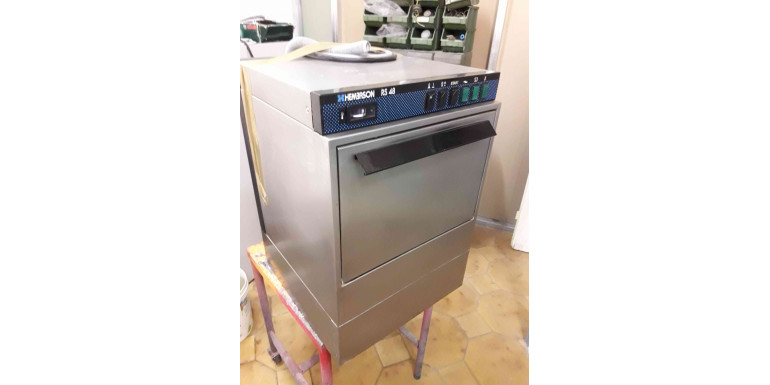
If you are weighing a manufacturer part against an equivalent, read our guide to original vs aftermarket spare parts. Machines currently available are listed in our used equipment section, such as the used Hemerson RS 48 glasswasher. If you are also after a second-hand slicer, the inspection method is covered in our used meat slicer buying guide.
Frequently asked questions
Is a used commercial glasswasher worth buying for a bar?
Yes, if the machine passes a full test cycle and parts for the brand are still available. A glasswasher is built from standard components (heating elements, pressure switches, pumps, solenoid valves) that can be replaced without changing the whole machine. Avoid units with no data plate or with a scaled-up tank and boiler.
What is the difference between a glasswasher and a bar dishwasher?
The washing principle is the same; basket size, clearance and power differ. A glasswasher usually takes a 35x35 or 40x40 cm rack, while an undercounter dishwasher takes a 50x50 cm rack that also holds dinner plates and trays.
What temperature does a commercial glasswasher wash at?
According to manufacturer spec sheets the tank runs at around 55–65 °C and the final rinse uses boiler water at about 80–90 °C. If the rinse comes out lukewarm, check the boiler element and thermostat.
Does a glasswasher need a water softener?
With hard water, yes: it protects heating elements, boiler and nozzles from limescale and gives clearer glasses. Some machines have one built in; otherwise an external softener is installed and regenerated with salt at regular intervals.
Why does my dishwasher keep filling with water?
The usual causes are a faulty pressure switch or a blocked pressure tube, a solenoid valve that does not close, or an overflow pipe that no longer seals. Start with the pressure switch tube and the overflow seal, which are the simplest checks.
In short
A used glasswasher or bar dishwasher can be a sound purchase if you pick the right basket size, check the power supply and drain, and run a full test cycle while watching temperatures, dispensers and seals. To keep it running, heating elements, pressure switches, spray arms, filters and softener parts are in our glasswasher and dishwasher spare parts category: have the data plate and the part code to hand.