
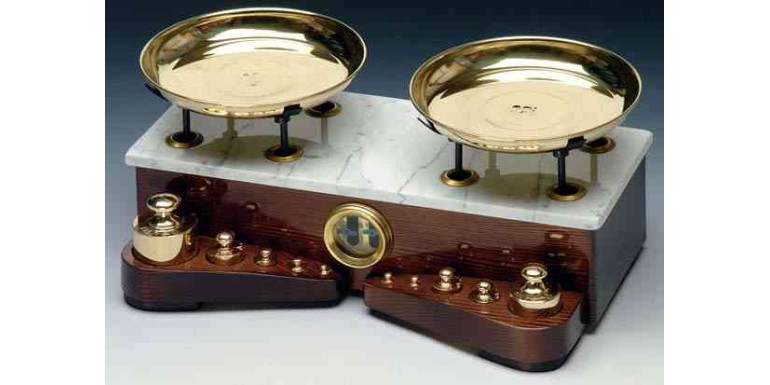
Two-pan balance: how it works, weights and calibration
A two-pan balance weighs by comparison: the goods go on one pan, calibrated weights from the weight set go on the other, and when the pointer settles in the centre the mass of the goods equals the sum of the weights. It has no springs and no electronics, so it needs no power: its accuracy depends on the quality of the weights, the condition of the knife edges the beam pivots on, and correct adjustment.
How a two-pan balance works
The principle is an equal-arm lever: a beam rests on a central pivot and carries a pan at each end. If both arms are the same length, the beam balances only when the two pans carry equal masses. That is why a two-pan balance measures mass directly rather than weight force: the reading does not change with local gravity, unlike a spring scale.
Equal-arm balance with hanging pans
This is the oldest form, the "scales of justice" shape: the pans hang from chains or rods at the ends of the beam. It is sensitive, but the chains get in the way when you load the goods.
Roberval balance: pans above the beam
The two-pan counter scale found in shops is almost always a Roberval balance, named after the French mathematician Gilles Personne de Roberval, who presented the principle in 1669. The pans sit above the beam on two vertical columns; underneath, a second link forms an articulated parallelogram with the beam. The parallelogram keeps the columns vertical, so in theory the reading does not depend on where on the pan you place the load. The practical advantage: open pans that are easy to load and clean.
Knife edges, bearings and pointer
In a good mechanical balance the beam does not turn on an ordinary pin but on knife edges: hardened steel prisms with a sharp edge resting on flat bearings of steel or hard stone. A pointer shows when the beam is in balance. Rounded, chipped or rusty knife edges are the first cause of a "lazy" balance that stops in a different position every time.
Pan balance, steelyard, dial scale, electronic scale: the differences
"Pan scale" and "antique scale" are used for instruments that work in very different ways:
| Type | Principle | How you read the weight | Power | Typical use |
|---|---|---|---|---|
| Equal-arm balance (hanging pans) | Equal-arm lever, comparison of masses | Sum of the calibrated weights | None | Laboratory, teaching, collecting |
| Roberval two-pan balance | Articulated parallelogram, comparison of masses | Sum of the calibrated weights | None | Shop counter, bakery, pastry, kitchen |
| Steelyard | Unequal-arm lever with a sliding poise | Position of the poise on a graduated bar | None | Markets and farms, heavy loads |
| Dial scale | Levers and counterweights (or springs) moving a needle | Graduated dial | None | Delis and grocers of the past, decoration |
| Electronic scale | Load cell converting deformation into an electrical signal | Digital display, often with price computing | Mains or battery | Retail today |
How a dial scale works, and how to find its parts, is covered in our guide on how a dial scale works; here we focus on the two-pan balance. Electronic scales use load cells instead.
Capacity and weight set: choosing a two-pan balance with weights
Capacity is the maximum load each pan can carry without damaging the knife edges and the beam. The counter two-pan balances in our range go from 1 kg to 20 kg. A small balance is more sensitive on small doses; a large one handles bread, fruit or meat.
The weight set is the collection of calibrated weights that comes with the balance. Two things to check:
- Total of the weight set versus capacity: with a 1 kg set you can weigh at most 1 kg of goods, even if the balance can carry more. If the set is smaller than the capacity, you need extra weights to use the full range.
- Composition: under OIML R 111, nominal values follow the 1, 2, 5 series in each decade (for example 500 g, 200 g, 200 g, 100 g, 50 g...), so a few pieces can make up any value.
In our scales and platforms category you will find three configurations: a 1 kg brass two-pan balance with a 1 kg weight set, with pans of about 170 mm; a 5 kg two-pan balance with a 2 kg weight set; and a 20 kg two-pan balance without weights, for those who already own a set.
Weight classes (OIML R 111)
The international recommendation OIML R 111 sorts weights into accuracy classes E1, E2, F1, F2, M1, M2 and M3, from most to least accurate. The maximum permissible error for a 1 kg weight is ±0.5 mg in class E1, ±5 mg in F1, ±50 mg in M1 and ±500 mg in M3.
How to use a two-pan balance
- Place the balance on a firm, level surface, away from draughts and vibration.
- With the pans empty, check that the pointer settles in the centre (zero).
- Put the goods on one pan, always the same one.
- Add weights to the other pan starting with the largest: if the weight pan drops, remove the last weight and try the next smaller one.
- When the pointer swings evenly about the centre and comes to rest at zero, add up the weights: that is the mass of the goods.
Calibrating and adjusting a two-pan balance
A note on terms: strictly, calibration means comparing the instrument with reference standards to find its error; adjustment is the work that brings it back within tolerance. In everyday shop language both are called "calibrating".
Zero adjustment
If the pointer does not return to the centre with empty pans, the balance needs re-balancing. Depending on the model, you turn an adjusting nut or screw on the beam, or add or remove material in a small adjustment cavity under one of the pans. First clean the pans: the imbalance is often just dirt.
Equal-arm test
If the arms are not exactly equal, the balance is wrong even when the zero is correct. The test is simple: weigh the same object on one pan, then on the other. If the results differ, the true mass is close to the average of the two (the double-weighing method) and the beam needs adjusting.
Sensitivity and repeatability test
With a load in balance, add a small weight (say 1 g on a 1 kg balance): the pointer should move clearly. If repeated weighings leave the pointer at a different spot each time, the knife edges and bearings are worn or dirty.
Care and cleaning
- Wipe the pans with a damp cloth and dry them at once; never immerse the balance in water.
- Do not oil knife edges or bearings: oil traps dust and increases friction.
- Do not drop goods onto the pans: shocks damage the knife edges.
- Keep the weights in their case: a dented or dirty weight no longer matches its nominal value.
- Never swap pans between balances: pans and beam are balanced together.
Selling by weight with a two-pan balance: the legal side
In the EU, scales used for commercial transactions and for working out the price in direct sales to the public are non-automatic weighing instruments covered by Directive 2014/31/EU, transposed in Italy by amending Legislative Decree 517/1992 (through Legislative Decree 83/2016). A new instrument for these uses must have passed conformity assessment and carry the CE marking with the supplementary metrology marking (a capital M and the last two digits of the year in a rectangle) plus the notified body number.
In Italy, once in service the scale is subject to periodic verification (verificazione periodica) under Ministerial Decree no. 93 of 21 April 2017. Its Annex IV sets the intervals: 3 years for non-automatic weighing instruments and 4 years for weights. The owner must notify the Chamber of Commerce within 30 days of putting the instrument into use, request the next verification at least five working days before the previous one expires, keep the metrological logbook and leave seals and marks intact. For non-automatic weighing instruments, fines range from 500 to 1,500 euros per breach. Other countries have their own in-service rules, so check with your local weights and measures authority.
In short: a decorative, vintage or unmarked two-pan balance is not legal for selling by weight until it carries the required marks and passes verification. For home use, teaching or display there are no metrological obligations.
Used and antique scales: what to check when buying
A good mechanical balance lasts decades, so used scales are often a sound buy. Check first:
- that with empty pans the pointer returns to zero and swings freely, without sticking;
- the double-weighing result on both pans, if you can bring a known weight;
- the knife edges: sharp, with no rust or chips;
- that the beam is straight and the pans are the original pair of that balance;
- the weight set: complete, with no dents and with legible values;
- if it is for trade, the presence of metrological seals and marks and of the logbook.
Original spare parts for antique balances are rare: pans, knife edges and weights often have to be salvaged. Our weight scale spare parts category carries parts such as keypads, membranes and dampers, and our used equipment section also includes second-hand mechanical and electronic scales. The same method applies to any second-hand equipment: see our used meat slicer buying guide.
Frequently asked questions
What is a two-pan balance called?
The general name is an equal-arm balance; the counter model with the pans above the beam is called a Roberval balance, after the mathematician who described the principle in 1669.
What are the weights of a two-pan balance for?
The weights are the reference the goods are compared with: the balance shows no number, it only tells you when the two pans are in equilibrium. The mass of the goods is the sum of the weights on the other pan, so the weighing can never be more accurate than the weights themselves.
Can I sell by weight with a two-pan balance?
Yes, but only if it is a legal metrological instrument: valid markings under Directive 2014/31/EU and, in Italy, periodic verification every 3 years under Ministerial Decree 93/2017, with the weights verified every 4 years. An unmarked vintage balance can only be used for non-commercial purposes.
Two-pan balance or electronic scale?
An electronic scale is faster and computes the price, which is why it dominates retail counters. A two-pan balance needs no mains or batteries, has no circuit boards to fail and lasts decades, making it ideal for laboratories, pastry work or teaching.
Conclusion
A two-pan balance is a simple but accurate instrument, as long as you choose the right capacity, pair it with a suitable weight set and look after its knife edges and adjustment. If you need it for selling by weight, check markings and periodic verification before use. Browse the models in our scales and platforms category and the components in our spare parts section.