
Slicer belt: types, sizes and how to replace it
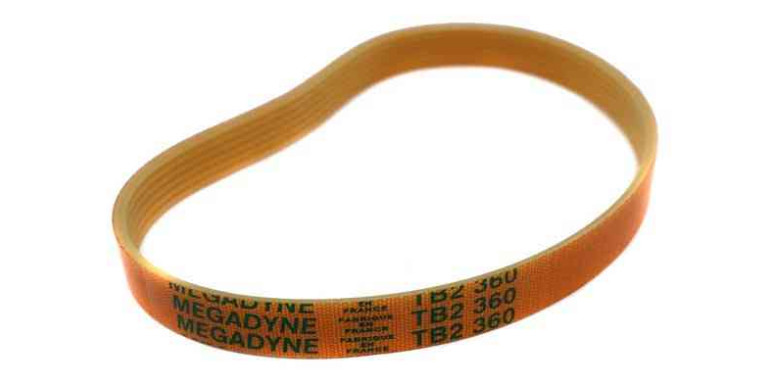
A slicer belt carries the drive from the motor to the blade, and on most belt-driven meat slicers it is one of three kinds: a flat ribbed belt (codes such as TB2 12x360 with 6 ribs, or J 23x381), a V-belt (for example 6x300 or 8x530) or a toothed timing belt (for example 196XL037). To replace it you need the same code as the original: profile, width or rib count, and length all have to match.
Why slicers use a drive belt
On a belt-driven slicer the motor is not coupled directly to the blade: a belt runs between the motor pulley and the blade hub pulley. The drive is quiet and inexpensive, and the belt is a low-cost part that can be changed without removing the motor. The alternative is a gear drive, better suited to continuous work on hard products; the trade-offs between the two are covered in our guide on how to choose a professional meat slicer.
The belt is a wear part. Over the hours it stretches, hardens and loses grip. Once it slips, the blade loses speed exactly when it bites into the product.
Types of slicer belt
Flat ribbed belts (TB2, J, poly-V)
What the spare parts trade calls a flat belt for a slicer is almost always a ribbed belt: flat on the back, with longitudinal ribs on the inside that run in matching grooves on the pulley. It is the most common type on belt-driven slicers. Our flat belts come in two main profiles:
- TB2: identified by width x length plus rib count, for example the TB2 12x360 flat belt with 6 ribs (also listed for FAC F300CL, Duegi 250 and General Macchine 220 GLS). It is the profile used across the whole range of Sirman slicer belts (for example TB2 20x380 with 10 ribs for the Agata, Gemma, Palladio and Raffaello) and on Berkel models such as the TB2 22x535 11-rib belt for the Berkel Premier and Futura.
- J (PJ): a standardised poly-V profile with 2.34 mm between ribs. The code may give the length in millimetres ("J 23x381, 10 ribs") or in tenths of an inch: "320J12" means 32.0 inches long (about 813 mm) with 12 ribs.
TB2 and J are not interchangeable: the rib pitch differs, so a belt of one profile will not seat properly in a pulley made for the other. Other poly-V profiles exist (PH, PK, PL and PM, ISO 9982), but they are much rarer on slicers.
The original RGV belts are the same kind and are listed by rib count and length: 6 ribs and 310 mm for the 195 GL and 220, 7 ribs and 330 mm for the Dolly 22/25 series.
V-belts (trapezoidal belts)
A V-belt has a wedge-shaped section and sits down in the pulley groove, gripping on its sides. Slicers use small sections, listed as section x length in millimetres: the 6x280 V-belt fits, for example, the RGV 250 and 250S, ABO 220 and FAC 220, while the 8x530 is listed for the ABM 330, 350 and 370V. A 6 section and an 8 section cannot be swapped.
Industrial V-belts use standard letter-and-number codes instead:
- Z = 10x6 mm section, A = 13x8 mm section (top width x height). The number is the inside length in inches: A57 has an inside length of 1450 mm, Z24 of 610 mm.
- XPZ (and SPZ) are narrow-section belts, 9.7x8 mm; XPZ is the cogged version, with notches on the inside that make it more flexible on small pulleys. They are ordered by datum (pitch) length in millimetres.
These sections are more common on other equipment than on slicers, and you will find them under belts for other machinery.
Toothed timing belts
A toothed belt has cross teeth that mesh with the pulley: it cannot slip and keeps an exact drive ratio. Among our toothed belts for slicers the imperial profiles XL (5.08 mm pitch) and L (9.525 mm pitch) dominate. The code reads like this:
- 196XL037: 196 = length in tenths of an inch (19.6" = 497.84 mm), XL = profile, 037 = width in hundredths of an inch (3/8" = 9.5 mm). In our part names the width also appears rounded, as in "H.10".
- 225L100: 22.5" long (571.5 mm), L profile, 1" wide (25.4 mm).
One example is the RGV Ausonia 220, which runs a 182XL037. Metric profiles also exist: T5 or T2.5 mean a trapezoidal tooth with a 5 or 2.5 mm pitch (we stock a 177.5 mm T2.5 for Epelsa scales), while HTD (e.g. 5M) has rounded teeth. Profiles with the same pitch but a different tooth shape are not compatible.
Table: belt types, codes and sizes
| Belt type | Example code | How it is measured | Typical use (from our catalogue) |
|---|---|---|---|
| Flat ribbed TB2 | TB2 16x345, 8 ribs | Width (mm) x length (mm) + rib count | Sirman slicers, Berkel Premier/Futura, Essedue, Fia Boston, RGV Kelly 300 |
| Poly-V J profile | J 23x381 10 ribs, 220J12 | Rib count (2.34 mm pitch) + length in mm or tenths of an inch | Swedlinghaus slicers, Sirman PPN 10 |
| Small-section V-belt | 6x300, 8x530 | Section (6 or 8 mm) x length (mm) | RGV 250, ABO 220, FAC 220, ABM 330/350/370V |
| Classic V-belt | Z24, A57 | Letter = section, number = inside length in inches | Other machinery |
| Imperial timing belt | 196XL037, 225L100 | Length in tenths of an inch, profile, width in hundredths of an inch | RGV Ausonia 220, CAD Carmen 19, mixers (240XL050) |
| Metric timing belt | T2.5-177.5 | Pitch (mm) - length (mm) | Epelsa scales |
How to read the code or measure an old belt
The most reliable reference is the code printed on the back of the fitted belt: if you can read it, that is all you need. If it has worn off, you need three measurements.
- Profile: longitudinal ribs, a single V, or cross teeth. On a timing belt, count the teeth: multiplied by the pitch they give the length (95 teeth x 5.08 mm = 482.6 mm, i.e. a 190XL).
- Width or rib count: measure the width with calipers and count the ribs on the inside. Two belts of the same length but with a different number of ribs are not interchangeable.
- Length: the belt's circumference. Check which length the code refers to: inside, outside or pitch (datum) length, measured through the middle of the belt. On V-belts the datum length is longer than the inside length by an amount that depends on the section: an XPZ with a 1180 mm datum length, for example, measures 1142 mm inside.
A used belt has almost always stretched a little: if you measure the old one, pick the nearest standard size and, if in doubt, check the travel left on the tensioner. Always give the make and model of the slicer too. Our guide to original vs aftermarket spare parts explains why, for a belt, the code matters more than the brand.
Signs of a worn slicer belt
- the blade slows down or stalls when it enters the product, especially with cold meat or cheese;
- slipping or squealing at start-up;
- a shiny, glazed surface on the ribs or sides;
- cracks across the ribs, frayed edges, missing ribs or teeth;
- the tensioner is at the end of its travel and the belt is still slack.
If the motor will not start at all, or starts and trips, the fault is almost always electrical: see slicer won't start: electrical faults. For routine checks of the belt along with the rest of the machine, see our slicer maintenance and sharpening guide.
How to replace a slicer belt, step by step
The details vary between models, but the sequence is always the same. If you are not confident you can put everything back correctly, leave the job to a technician.
- Unplug the slicer at the socket: switching it off is not enough.
- Close the thickness gauge to zero and keep the blade guard fitted; wear cut-resistant gloves, as the pulleys sit close to the blade hub.
- Remove the cover that protects the drive (at the back, on the side or underneath, depending on the model).
- Release the tension: usually you loosen the bolts on the motor plate or the tensioner and move the motor towards the blade pulley.
- Take off the old belt and compare it with the new one: same profile, same width or rib count, same length.
- Fit the new belt without levering it over the pulley flange with a screwdriver, which damages the ribs or the tension cords. Make sure every rib sits in its groove and that the pulleys are aligned.
- Re-tension, tighten the motor plate bolts and turn the blade by hand for a couple of revolutions.
- Refit the cover and test the slicer empty, then with product.
How to check belt tension
The right tension is the lowest one at which the belt does not slip under peak load. For V-belts a common rule among manufacturers is a deflection of about 1/64 inch per inch of span, roughly 1.6 mm per 100 mm between pulley centres, pressing at the middle of the span. A timing belt needs less tension: it should be snug without the teeth jumping. Do not overdo it: an over-tight belt overloads the motor and blade hub bearings, runs hot and wears out sooner. Check the tension again after the first few hours, as a new belt beds in.
Checklist before you order a belt
- Make and model of the slicer (from the rating plate).
- Code printed on the back of the old belt, if readable.
- Profile: ribbed (TB2 or J), V-belt, toothed (XL, L, T).
- Width in mm and number of ribs or teeth.
- Length, stating whether inside, outside or pitch length.
- Condition of the pulleys and bearings: a worn pulley will chew up a new belt too.
Frequently asked questions
What is the difference between a flat belt and a V-belt?
A flat slicer belt has several low ribs on the inside and runs on multi-groove pulleys; a V-belt has a single wedge section that grips on the sides of the groove. The pulleys are different, so one cannot replace the other.
Can I fit a J belt instead of a TB2?
No. Even at a similar width the rib pitch is different, so the belt will not run properly in the pulley grooves: it slips and wears quickly. You need the same profile as the original.
How often should a slicer belt be replaced?
There is no fixed interval: it depends on working hours, what you slice and how the belt is tensioned. Change it when the signs of wear appear (blade slowing under load, slipping, cracks or glazing) or when the tensioner has no travel left.
How do I change the belt on a Berkel, RGV or Sirman slicer?
The basic procedure is the same for every brand: unplug, remove the cover, release the tension, fit a new belt with the same code, re-tension. What changes is where the cover sits and how the tensioner works; the codes for each model are listed on our Sirman belt, RGV belt and flat belt pages.
Conclusion
Once you know the type and the code, finding the right belt is simple: browse our flat belts, V-belts and toothed belts for slicers. If you would rather have a technician identify and fit the belt, our slicer repair service covers Rome and Lazio.