
Bestsellers
- -10%
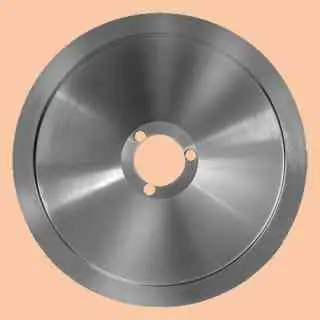
blade for slicer 250 diameter 25cm three hole central hole 40mm c45 rgv fac e
"
BLADE FOR SLICER 250 DIAMETER 25CM THREE HOLE CENTRAL HOLE 40MM C45 RGV FAC E
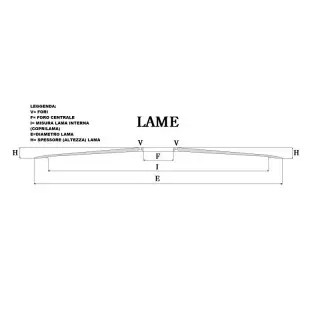
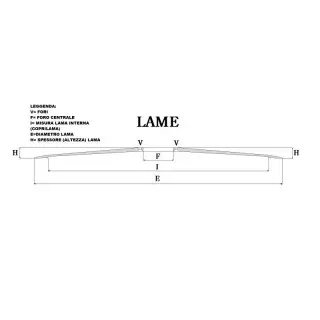
| (E) Diameter Blade | 250 | |
| (V) Number of holes | 3 | |
| (F) Dim. Central hole | 40 | |
| (H) Blade height (thickness) | 17.5 | |
| (I) Inner blade measurement (blade guard) | 210 |
VISIT THE BLOG FOR MORE INFORMATION
"
- -10%
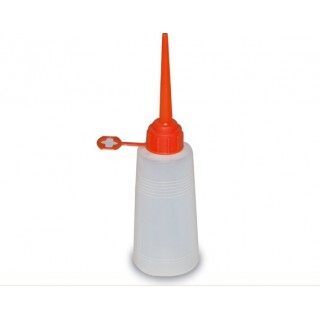
neutral white oil pack for slicers 50 ml
Food-grade neutral white oil, 50 ml, for lubricating gravity-feed and flywheel slicers of any brand: colourless, odourless and tasteless, it protects the carriage, food pusher and blade from friction and rust. Do not use cooking oils.
- -10%
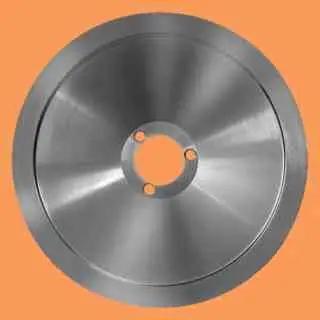
blade for slicer 220 diameter 22cm three hole central hole 40mm c45 rgv and other brands
BLADE FOR SLICER? 220/40/3/180 / 15,5 C45 FOR ABO - KOLOSSAL - OMAS -VAN DALL
(E) Diameter Blade 220
(V) Hole Number 3
(F) Dim. Central Hole 40
(H) Blade height (thickness) 15.5
(I) Internal blade size (cap) 180
VISIT THE BLOG FOR MORE INFORMATION
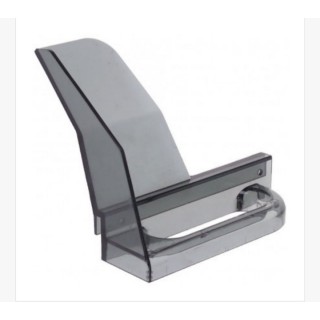
hand protection slicer fac and swedlinghaus model 195 220 250r 250e
Carriage hand guard for FAC and Swedlinghaus gravity-feed slicers, models 195 / 220 / 250R / 250E, CE and CE domestic versions. Safety shield between the hand and the blade during slicing: mandatory component, to be replaced if broken or missing. Hole centre distance 14.9 cm (measurement to check for compatibility). Specific to FAC/Swedlinghaus, not interchangeable with RGV models.

Subcategories
-
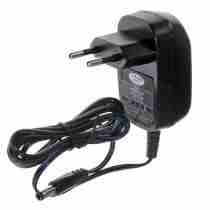 <p>The power supply converts mains current into low-voltage DC power for electronic scales and cash registers.</p> <p><strong>How to choose the right part</strong>: you need the <strong>output voltage</strong> (e.g. 7.5V, 9V, 12V, 16.5V), the <strong>current</strong> (e.g. 500mA, 1A, 4A) and the <strong>connector type</strong> (e.g. barrel jack) — all three values must match the appliance being powered, not just the voltage.</p> <p><strong>Compatibility by brand</strong>: available for Eurobil (several series: early, latest, for BC100-BC060 display), Dibal (mod. F210, C102), Omega (mod. Basica 200), Italiana Macchi and other scale/register manufacturers.</p> <p>For other scale spare parts go back to <a href="/en/weight-scale-spare-parts.html">Scale Spare Parts</a>.</p> <p><strong>Frequently asked questions</strong></p> <p><strong>Can I use a universal power supply instead of the original?</strong><br>Only if voltage, current and connector type match exactly: a power supply with different specs may not work or could damage the appliance.</p> <p><strong>How do I know if the power supply needs replacing?</strong><br>Typical symptoms are a scale/register that won't turn on, switches off by itself, or shows an unstable display.</p>
 -
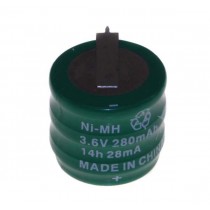 <p>Replacement batteries for circuit boards and scales: they keep memory, clock or backup functions active when the device is switched off or in case of a power outage.</p> <p><strong>Backup batteries</strong>: small, low-capacity batteries (e.g. 3.6V 300mA, 2.4V 60mAh) that power the board's internal memory when disconnected from the mains — often with 3 pins for direct mounting on the circuit.</p> <p><strong>Rechargeable and lead-acid batteries</strong>: higher capacities (from 1.2Ah up to 7.2Ah, 6V/12V) for portable scales or extended battery-powered operation, including NI-MH kits for specific brands (Omega, Italiana Macchi, Lario).</p> <p><strong>How to choose the right part</strong>: check voltage, capacity (mAh/Ah) and physical dimensions — all must match the original for correct fit and operation.</p> <p>For other electronic spare parts go back to <a href="/en/electronic-spare-parts.html">Electronic Spare Parts</a> or see <a href="/en/weight-scale-spare-parts.html">Scale Spare Parts</a>.</p> <p><strong>Frequently asked questions</strong></p> <p><strong>How do I know if I need the backup battery?</strong><br>If the board loses its settings or the time every time it's unplugged from power, the backup battery is probably worn out.</p> <p><strong>Can I use a battery with higher capacity than the original?</strong><br>Yes, as long as voltage and physical dimensions are compatible: a higher capacity only means longer runtime.</p>
 -
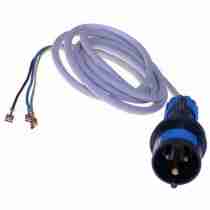 <p>Power cables and plugs for professional machinery, sized for the power and voltage required by the appliance.</p> <p><strong>Single-phase cables</strong>: with Schuko plug, available for hot plates, toasters and ovens up to 3.5kW or up to 5kW (Kado version, the quick connector for internal wiring).</p> <p><strong>Three-phase cables</strong>: with CE 230V or 400V plug, 16A, 2 metres long.</p> <p><strong>Separate plugs</strong>: the 400V 4-pole three-phase plug (16A) is also available on its own.</p> <p><strong>How to choose the right cable</strong>: check the appliance's power (kW), voltage (single-phase 230V or three-phase 400V) and plug amperage (16A) — all figures that must match your machine's specifications.</p> <p>For other electronic spare parts go back to <a href="/en/electronic-spare-parts.html">Electronic Spare Parts</a>.</p> <p><strong>Frequently asked questions</strong></p> <p><strong>How do I choose between a 3.5kW and 5kW cable?</strong><br>Check the maximum power draw of your appliance (shown on the nameplate): an undersized cable can overheat.</p> <p><strong>What does "with Kado" mean?</strong><br>It indicates the presence of a quick connector for internal wiring to the machine, useful for simpler installation.</p>
 -
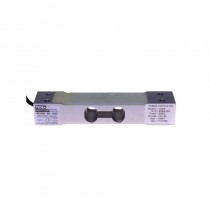 <p>load cell for balance and system of <span>measurement</span></p> <p><span>A </span><b>load cell</b><span> is a type of transducer, specifically a force transducer. It converts a force such as tension, compression, pressure, or torque into an electrical signal that can be measured and standardized. </span></p>
 -
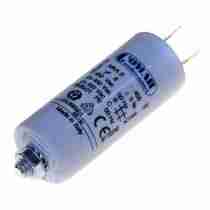 <p>The starting capacitor provides the initial kick to the single-phase motor of slicers and meat grinders: a worn-out or damaged capacitor is a common cause of a motor that "hums" but doesn't start.</p> <p><strong>How to choose the correct part</strong>: check the <strong>capacitance</strong> in mF (microfarad, sometimes shown as µF — same unit) — available from 2.5 to 50 mF — and the <strong>voltage</strong> (some models require 400V). The correct capacitance is the one shown on the original capacitor or on the motor's rating plate.</p> <p><strong>Symptoms of a capacitor that needs replacing</strong>: motor humming without starting, starting only if helped to turn manually, or overheating quickly.</p> <p>For other electronic spare parts go back to <a href="/en/electronic-spare-parts.html">Electronic Spare Parts</a>.</p> <p><strong>Frequently asked questions</strong></p> <p><strong>Can I use a capacitor with a different capacitance than the original?</strong><br>No, a capacitance that's too low won't give the motor enough of a kick, while one that's too high can damage it: always use the value shown on the original component.</p> <p><strong>How do I know if it's the capacitor or the motor that's the problem?</strong><br>If the motor hums but doesn't start, and turns normally when helped by hand, the capacitor is the main suspect.</p>
 -
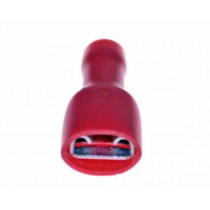 <p>Faston terminals and cable lugs are used to connect electrical wires to switches, boards and other components without soldering, by crimping.</p> <p><strong>Faston terminal</strong>: <strong>female</strong> or <strong>male</strong> connector (flat, plugs in without soldering), available in 6.5mm section — the colour (red, blue, yellow) indicates the compatible cable section according to the DIN standard, it's not just cosmetic.</p> <p><strong>Ring lug terminal</strong>: ring-shaped terminal for screw fastening (4mm hole), useful where a fixed, secure connection is needed instead of a quick plug-in.</p> <p><strong>How to choose the right colour</strong>: red for smaller cable sections, blue for medium sections, yellow for larger sections — always check your cable's section before buying.</p> <p>For other electronic spare parts go back to <a href="/en/electronic-spare-parts.html">Electronic Spare Parts</a>.</p> <p><strong>Frequently asked questions</strong></p> <p><strong>What's the difference between male and female faston?</strong><br>They plug into each other: the male is the flat connector, the female houses it — check which one you need based on the component you are connecting.</p> <p><strong>Why does the faston colour matter?</strong><br>It indicates the compatible cable section according to the standard: the wrong colour can mean an unsafe connection.</p>
 -
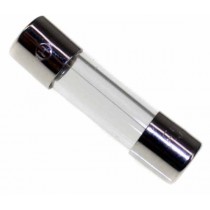 <p>Glass fuses protect the electronic circuits of machines (control boards, power supplies) from overcurrent: when the current exceeds the rated value, the internal filament breaks, saving the board from more serious damage.</p> <p><strong>Rating</strong>: <strong>500mA</strong> and <strong>1A</strong>, standard 5x20mm size, sold in packs of 10. The range also includes green and yellow 220V indicator lamps for control panels.</p> <p>For other electronic spare parts go back to <a href="/en/electronic-spare-parts.html">Electronic Spare Parts</a>.</p> <p><strong>Frequently asked questions</strong></p> <p><strong>How do I choose the right rating?</strong><br>It must match the blown original fuse exactly: a different value won't correctly protect the circuit.</p> <p><strong>Why does the fuse keep blowing?</strong><br>If it blows repeatedly, the problem isn't the fuse but a fault upstream (board or component) that needs identifying before replacing it again.</p>
 -
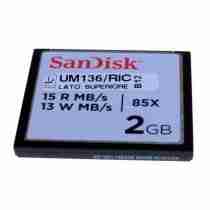 <p>The electronic journal is the digital log that records every transaction from a cash register or scale, replacing the old paper roll with a searchable digital memory.</p> <p><strong>Models available</strong>: a <strong>64 MB</strong> electronic board for Sarema, Sweda and Data System registers, and a dedicated version for <strong>Dataprocess</strong>.</p> <p>For other electronic spare parts see <a href="/en/electronic-spare-parts.html">Electronic Spare Parts</a>.</p> <p><strong>Frequently asked questions</strong></p> <p><strong>What is the electronic journal for?</strong><br>It automatically records every transaction, useful for sales traceability and, in some cases, as a reference during an inspection.</p> <p><strong>Does the electronic journal fit any cash register?</strong><br>No, it must be chosen for the exact brand and model of your cash register: check compatibility before ordering.</p>
 -
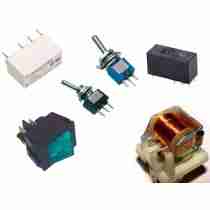 <p>Switches and selectors are the basic electrical controls of slicers, meat grinders and cheese graters: they switch the machine on/off or select between different functions.</p> <p><strong>Main types</strong>: <strong>key switch</strong> (locks power-on to whoever holds the key), <strong>4 or 6-contact switch</strong> (for more complex wiring, e.g. with a built-in indicator light), <strong>bipolar</strong> switch, and <strong>piezo igniters</strong> for lighting pilot flames.</p> <p><strong>Other components</strong>: mechanical timers (e.g. 4-5 minutes, used on mussel washers and other cycle-based machines), coloured indicator lights (green/yellow, 220V).</p> <p><strong>Compatibility</strong>: available for Fama (single-phase meat grinder switch mod. 12/22), Fimar (mussel washer timer) and universal components for slicer/meat grinder/grater.</p> <p>For complete button panels go back to <a href="/en/pulsantiere-per-affettatrici-e-tritacarni.html">Button Panels</a>, for safety micro switches see <a href="/en/micro-switches-and-sensors.html">Micro Switches and Sensors</a>.</p> <p><strong>Frequently asked questions</strong></p> <p><strong>What's the difference between a 4-contact and a 6-contact switch?</strong><br>The number of contacts depends on how many functions/connections the switch handles (e.g. power-on plus indicator light): check your original switch's wiring diagram.</p> <p><strong>What is the key switch for?</strong><br>It prevents the machine from being switched on by anyone without the key, useful as a safety measure in workplaces with multiple operators.</p>
 -
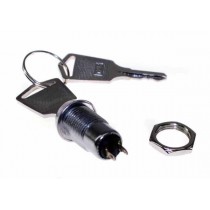 <p>Key switches and indicator lamps for professional machinery: the key switch (Japan CH17 and Poker models) allows power-on only to those holding the key, an extra level of safety compared to a simple lever or push-button switch.</p> <p>For the complete guide to all switch and selector types (lever, contact, with indicator) see <a href="/en/switches-and-selectors.html">Switches and Selectors</a>. The range also includes green and yellow 220V indicator lamps for the control panel.</p>
 -
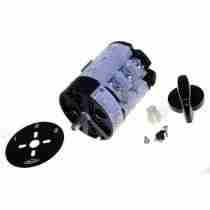 <p>The reversing switches and switches listed here are part of the <a href="/en/electronic-spare-parts.html">Electronic Spare Parts</a> range.</p> <p>For the complete guide on choosing the correct reversing switch (current, single-phase/three-phase) see the dedicated page <a href="/en/meat-grinder-switches-and-reversing-switches.html">Switches and Reversing Switches for Meat Grinder</a>.</p>
 -
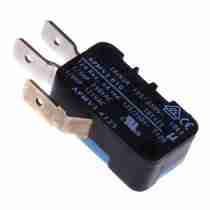 <p>Micro switches and magnetic sensors are safety components: they detect when a guard (blade cover, lid, hopper) is opened and cut power to the motor, preventing the machine from running while open.</p> <p><strong>Micro switch</strong>: a mechanical contact triggered by a lever or button — available with 1, 2 or 3 contacts, universal or dedicated (e.g. for hopper, for thickness gauge, for mixer).</p> <p><strong>Magnetic sensor</strong>: detects position through a paired magnet, with no direct mechanical contact — more common on bone saws and electronic control units (e.g. Minerva, Bizerba) for blade guard protection.</p> <p><strong>Compatibility</strong>: parts available for Giovenzana, Valko, Minerva, Bizerba and Omas — always check the rated voltage/current (e.g. 16A 250V) and connector type (e.g. 6.3mm faston) before ordering.</p> <p>For other electronic parts go back to <a href="/en/electronic-spare-parts.html">Electronic Spare Parts</a>.</p> <p><strong>Frequently asked questions</strong></p> <p><strong>Why won't the machine start even though everything looks fine?</strong><br>Often it's a micro switch or safety sensor not detecting the guard as properly closed: check that the blade cover/lid is correctly positioned before replacing the part.</p> <p><strong>What's the difference between a micro switch and a magnetic sensor?</strong><br>The first is a mechanical contact triggered physically; the second detects a magnet at a distance, with no direct contact — they are not interchangeable.</p>
 -
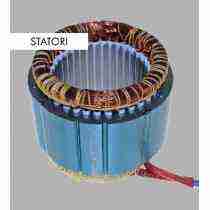 <p>The motor stator windings listed here for slicers and meat grinders are part of the <a href="/en/electronic-spare-parts.html">electronic spare parts</a> range.</p> <p>For the complete guide on how to choose the right lamination stack (height, outer diameter, voltage) see the dedicated page <a href="/en/engine.html">Motors and Stators for Slicer</a>.</p>
 -
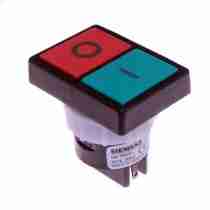 <p>The button panel is the control panel mounted on the machine's body: it houses the on/off buttons and, where present, the motor reversal selector, inside a cover plate that fixes to the machine body through a dedicated hole.</p> <p><strong>Main types</strong>: <strong>2-button</strong> panels (start/stop), <strong>3-button</strong> panels with motor reversal — especially useful on meat grinders and sausage fillers to clear the mouth when it jams — and versions with a <strong>power-on indicator light</strong>. There are also <strong>digital</strong> panels, which can only be connected to the specific electronic board of that model, and are not interchangeable with mechanical-button versions.</p> <p><strong>How to choose the right part</strong>: the panel must match the shape and diameter of the mounting hole (oval or round, typically 22-30 mm), the voltage and number of wires in the connecting cable, and the brand — FAC, Fama, Omas, RGV, Noaw, Celme and Sirman models often look similar but are not compatible with each other. The electrical module (switch plus indicator light if present) and the cover plate are usually available separately too, useful if only one of the two is damaged.</p> <p>Looking for a part for a specific machine or brand? <a href="/en/buttons-and-switches.html">Button Panels for Slicers</a>, <a href="/en/meat-grinder-button-panel.html">Button Panel for Meat Grinder</a>, <a href="/en/grater-button-panel.html">Button Panel for Grater</a>, <a href="/en/pulsantiere-impastatrici.html">Button Panels for Mixers</a> or <a href="/en/pulsantiere-sirman.html">Sirman Button Panels</a>. See also the <a href="/en/electronic-boards.html">Electronic Boards</a> some panels connect to.</p> <p><strong>Frequently asked questions</strong></p> <p><strong>What's the difference between a 2-button and a 3-button panel?</strong><br>The 2-button version only handles start and stop; the 3-button version adds motor reversal, useful for freeing the auger or blade when they jam.</p> <p><strong>Can I fit a button panel from another brand?</strong><br>Only if shape, hole diameter, voltage and wiring match: between different brands the look can be similar, but mounting or connections are often not interchangeable.</p> <p><strong>Do I need to replace the whole panel or just one part?</strong><br>If the fault is only cosmetic or in the cover, the cover plate alone is often enough; if the problem is electrical (won't switch on, worn contacts), the electrical module needs replacing.</p>
 -
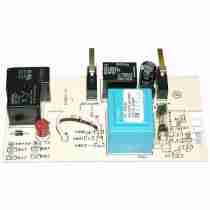 <p>Electronic boards are the heart of the motor control on slicers, meat grinders, cheese graters and bone saws: they manage start, stop and — depending on the model — motor reversal or the electric brake that stops the blade quickly for safety.</p> <p><strong>Main types</strong></p> <ul> <li><strong>Safety boards</strong>: complete with button panel and box, often required for workplace safety compliance.</li> <li><strong>With motor reversal</strong>: let you reverse the motor's direction, useful on meat grinders and mixers in case of jamming.</li> <li><strong>With electric brake</strong>: stop the motor much faster than natural coasting, reducing the risk of contact with moving parts.</li> <li><strong>Universal</strong>: compatible with several machines of the same type, without a dedicated button panel.</li> </ul> <p><strong>Available voltages</strong>: single-phase 220-230V and three-phase 380-400V. Always check your system's voltage and the one shown on the motor before ordering.</p> <p><strong>Compatibility by brand</strong>: boards available for Sirman, Fia Boston, Omas, Kolossal, Berkel, RGV and other manufacturers, often identifiable from the model printed on the original board (e.g. TG, SR, MW, IB).</p> <p><strong>How to choose</strong>: find your machine type (slicer, meat grinder or cheese grater) among the subcategories below, then compare voltage, board dimensions and the presence of a button panel with the part you're replacing. If in doubt, the code printed on the original board is the most reliable reference.</p> <p>Browse the subcategories to find the right part: <a href="/en/electronic-boards-for-slicer.html">Boards for Slicers</a>, <a href="/en/electronic-boards-for-meat-grinder.html">Boards for Meat Grinders</a>, <a href="/en/electronic-boards-for-grinder.html">Boards for Graters</a>.</p> <p><strong>Frequently asked questions</strong></p> <p><strong>What's the difference between a board with and without electric brake?</strong><br>The brake stops the blade within a fraction of a second of switching off, reducing exposure time to moving parts; it's often required by the most recent safety regulations.</p> <p><strong>How do I know the correct voltage?</strong><br>Check the motor's nameplate or the board you're replacing: 220-230V means single-phase, 380-400V three-phase.</p>
 -
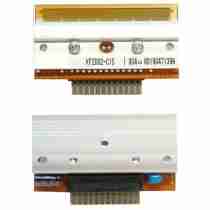 <p>The thermal print head is the component of the printer built into the scale that prints the label with weight, price and barcode: it's a part subject to wear from continuous contact with the paper during printing.</p> <p><strong>What you'll find in this section</strong>: <strong>200 dpi</strong> heads for Omega Poker models (KF2002-C1SXA, KF2002-GC20H, KA2002-DC90C), 3" thermal print head for Macchi CE9000 (in kit), complete APS printer mod. EPM 205 for Eurobil Sun Eco scales, and the complete kit for Mach 2008 (print head + connecting cable + bracket).</p> <p><strong>Sign of wear</strong>: white streaks or smudges on the printed label, faint or missing text, are the typical signs of a print head that needs replacing.</p> <p>For other electronic spare parts go back to <a href="/en/electronic-spare-parts.html">Electronic Spare Parts</a>.</p> <p><strong>Frequently asked questions</strong></p> <p><strong>How do I choose the right print head for my scale?</strong><br>From the exact model of your scale or built-in printer: each print head is compatible with specific models, it's not a universal part.</p> <p><strong>Is it worth buying the complete kit or just the print head?</strong><br>If the cable or bracket also show signs of wear, the complete kit avoids having to intervene again soon.</p>
 -
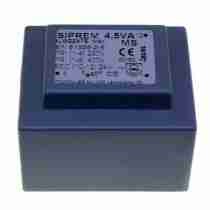 <p>The transformer steps down the mains voltage (220-400V) to the low voltage required by the control board or safety circuit, typically 24V.</p> <p><strong>Types</strong>: <strong>standard</strong> transformer (traditional winding) and <strong>toroidal</strong> (ring-shaped core, more compact and efficient) — available in various power ratings expressed in <strong>VA</strong> (e.g. 5VA, 8VA, 16VA, 80VA), to be chosen based on the current draw of the circuit being powered.</p> <p><strong>Compatibility</strong>: dedicated transformers available for SR/ITR family boards (e.g. AVM 220/380 24V 8VA), for Berkel (mod. M and M Quadro), Omas (T7802) and Sirman dispensers.</p> <p><strong>How to choose the right part</strong>: check input voltage (220/230/380/400V), output voltage (typically 24V) and power in VA — all three values must match the original or the requirements of the connected board.</p> <p>For the connected electronic boards go back to <a href="/en/electronic-boards.html">Electronic Boards</a> or <a href="/en/electronic-spare-parts.html">Electronic Spare Parts</a>.</p> <p><strong>Frequently asked questions</strong></p> <p><strong>What does the power rating in VA mean?</strong><br>It indicates the apparent power the transformer can supply: it must be chosen equal to or greater than the connected circuit's current draw, never lower.</p> <p><strong>What's the advantage of a toroidal transformer over a standard one?</strong><br>For the same power, it's more compact, more efficient and generates less magnetic dispersion.</p>
 -
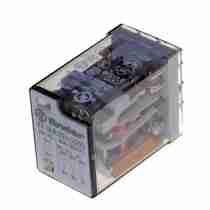 <p>The switching relay is an electrically-controlled switch: a small current on the coil opens or closes a higher-power circuit, used on control boards to activate motors, solenoid valves or other loads.</p> <p><strong>How to choose the right part</strong>: check the <strong>coil voltage</strong> (e.g. 24V AC/DC, 220/230V AC), the <strong>contact current</strong> (e.g. 5A, 16A) and the <strong>number of pins</strong> — all values must match the original, a relay with different specifications may not work or could damage the board.</p> <p><strong>Compatibility</strong>: available Finder relays (various series: 55.13, 56.44, 40.61, 40.31, 40.52, 62.23), Omron (mod. LY4, for Omas boards) and Klixon (mod. 4CR-650, for Omas).</p> <p>For other electronic spare parts go back to <a href="/en/electronic-spare-parts.html">Electronic Spare Parts</a>; for higher-power components see <a href="/en/contactors.html">Contactors</a>.</p> <p><strong>Frequently asked questions</strong></p> <p><strong>What's the difference between a relay and a contactor?</strong><br>The relay handles lower currents (signals, small loads); the contactor is rated for higher currents, typically for direct motor starting.</p> <p><strong>How do I find my relay's coil voltage?</strong><br>It's printed on the body of the original relay (e.g. "24V AC", "230VA"): it's the most reliable reference for replacement.</p>
 -
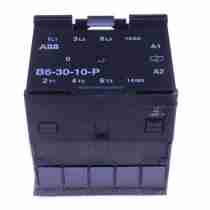 <p>The contactor is an electromechanical switch sized for high currents: it controls the direct starting of three-phase motors, unlike a relay, which handles signals and lighter loads.</p> <p><strong>Reversing contactor</strong>: a version that also allows reversing the motor's direction of rotation, useful on meat grinders and other machines with an unjamming function.</p> <p><strong>How to choose the correct part</strong>: check the <strong>coil voltage</strong> (e.g. 24V, 220V), the contactor's <strong>current/power rating</strong>, and the contact configuration (e.g. "3NO+1NC") — all values must match the original.</p> <p><strong>Compatibility</strong>: available ABB (B6/B7 series, VB6A/VB7A models), Siemens (3TK2031, 3TF2001 models) and Fimar.</p> <p>For lighter signal components see <a href="/en/relay-switches.html">Relay Switches</a>; for other electronic spare parts go back to <a href="/en/electronic-spare-parts.html">Electronic Spare Parts</a>.</p> <p><strong>Frequently asked questions</strong></p> <p><strong>What's the difference between a contactor and a relay?</strong><br>The contactor is sized for high currents (direct motor starting); the relay handles lower currents, typically signals or small loads.</p> <p><strong>When do I need a reversing contactor instead of a standard one?</strong><br>When the machine needs to be able to reverse the motor's direction of rotation (e.g. to clear a jammed auger).</p>
There are 6 products.
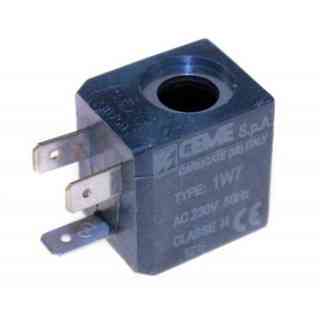
coil 220v solenoid valve gas slush machines gbg
220V coil for the gas solenoid valve of GBG granita machines. Controls the opening/closing of the refrigerant-circuit valve. Codes 1.024.106 / 1.024.130. Check voltage and fitting against the original.
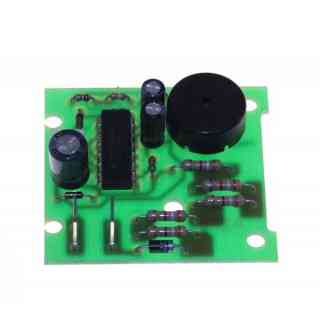
buzzer buzzer board
Acoustic-alarm board (buzzer) for food machines. Generates the audible signal (end of cycle/alarm). Code AGWSELE1049. Check size and connections against the original.
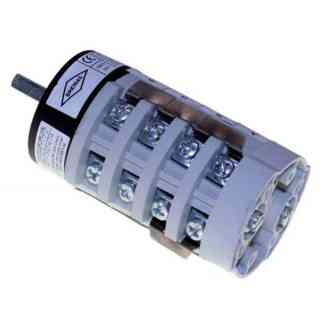
20a 8-pole switch 3 control positions 5x5 axis
20A, 8-pole, 3-position selector switch, 5x5 mm shaft. Rotary selector switching the control circuits (e.g. off/run/reverse). Code 1.015.104. Check rating, poles, positions and shaft against the original.
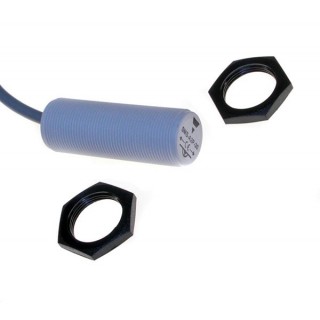
magnetic sensor for minerva bone saw control unit
Magnetic safety sensor replacement for the electronic control unit of La Minerva bone saws. It detects the closed position of the movable guard (door/drawer) and enables the motor to start only when the guards are correctly in place; part of the low-voltage (24V) redundant safety circuit of these bone saws.

- -10%
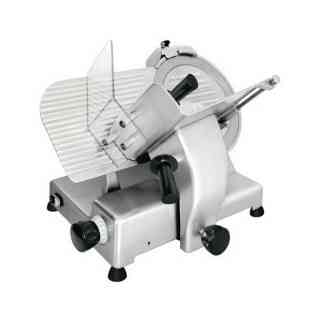
blade sharpening for slicer including two emery stones in rome service offered in 24h!
Ag work solution offers its customers in Rome an exclusive service to sharpen the blade of your slicer.
thanks to our extensive catalog of Smerigli we can find any solution.
exclusive for the area of ??Rome
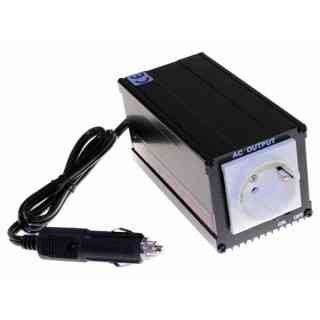
voltage inverter from 12v to 220v 300w
Voltage inverter from 12V to 220V, 300W. Converts 12V to 220V to power small loads without mains. Code AGWSELE0726. Check that 300W is adequate for the load.